April 15, 2027 @ 8:30 am – 1:00 pm
Location: W210ABC
Schoolcraft Business Club’s Pitch Competition: Open to all enrolled students.

April 15, 2027 @ 8:30 am – 1:00 pm
Location: W210ABC
Schoolcraft Business Club’s Pitch Competition: Open to all enrolled students.
To help better serve students and prepare them for an increasingly competitive job market, Schoolcraft College has comprehensively revamped its Mechatronics program.
Mechatronics describes the relationship between mechanical machines regulated by electrical control systems. It also encompasses computer engineering, systems engineering and programming.
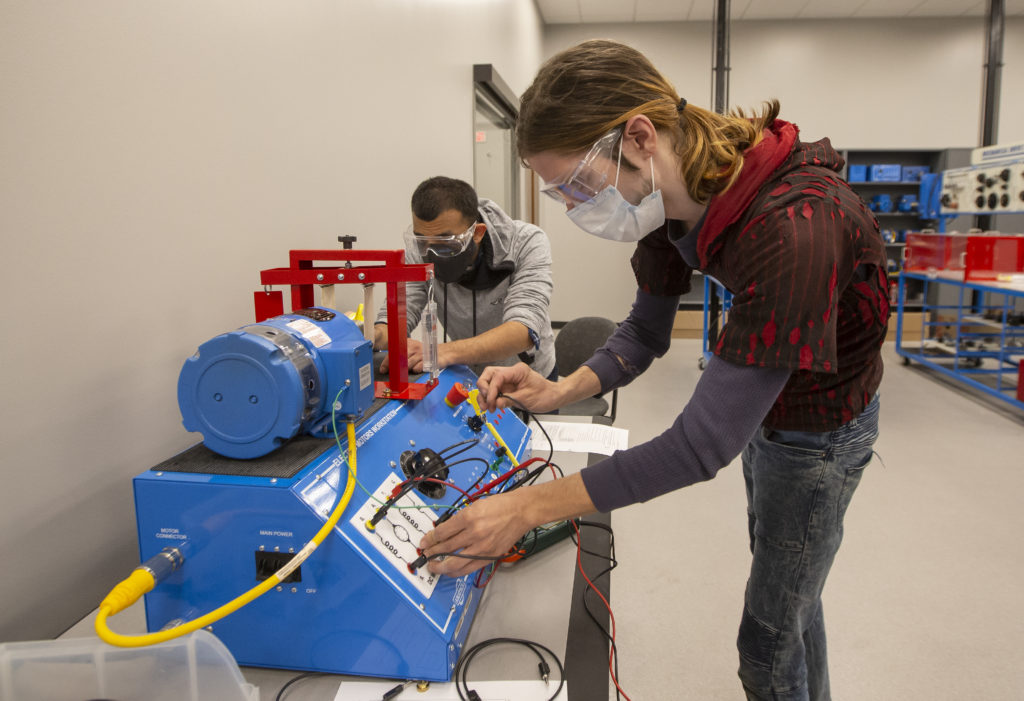
Starting with the Winter 2022 semester, the program will be known as Mechatronics Technology to reflect the increased hands-on classes and alignment with important industry standards.
“We’ve retooled our new Mechatronics Technology program to better help our students master an array of equipment in a variety of industries,” said Amy Jones, Associate Dean of Occupational Programs, Engineering & Technology. “Also, students will have the opportunity to earn important industry certifications.”
Leading the new course offerings is ROBAT101, Robot Tool Handling Operations and Programming. It serves as an applied introduction to HandlingTool™ software with an emphasis on safety, setup, recording and troubleshooting. It also includes basic applications of the HandlingTool™ software, including terminology, testing and refining the program. Further, robotic operations and hands-on application are covered to simulate and run robotic programs.
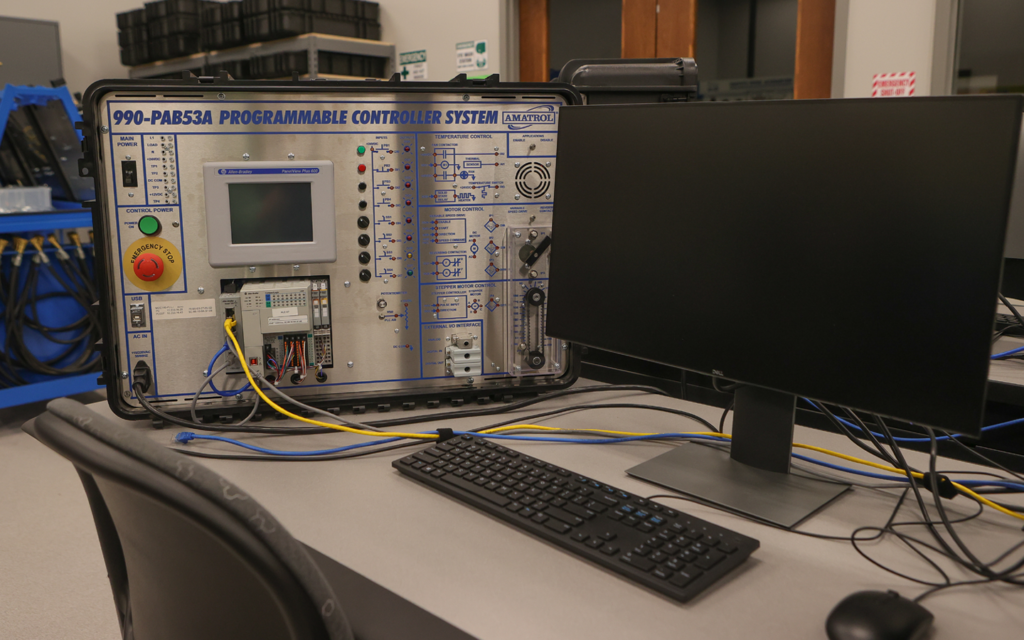
A key benefit in taking this course is that it is aligned to both Smart Automation Certification Alliance (SACA) and FANUC* standards.
“Earning these industry certifications can help students advance in their careers,” Jones said. “Schoolcraft College students can take the exams at no extra charge. Because we are now a SACA-certified location, we also can offer training to industry professionals to earn these certifications.”
Schoolcraft College’s Mechatronics Technology program focuses on the integration of mechanical, electrical (electronics), fluid power (hydraulics or pneumatics) and computer technologies to control machine movements. The students’ studies begin with courses in mechanics, sensors, basic electronics, pneumatics, control logic and robot programming and control.
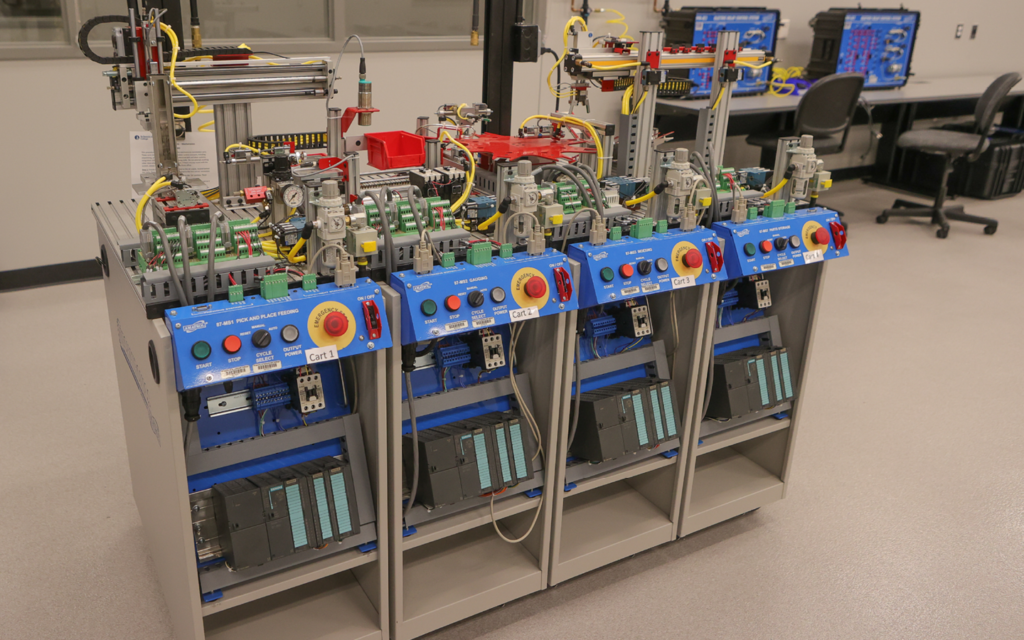
The program is not directly aimed at specific products. With the multiplicity of equipment presently in use, and the rapid advance and change in technology, the department stresses the development of a broad background that will enable students to find employment and be able to further their skills in a diversified number of industries, including:
According to federal government data, the average median salary for a person skilled in mechatronics technology is $60,000.
The College offers a Skills Certificate (18 credits), a Certificate (35 credits) and an Associate in Applied Science degree (62-68 credits) in Mechatronics Technology.
Read further information on Schoolcraft College’s Mechatronics Technology program.
*FANUC is a Japanese company with American headquarters in Rochester Hills, Michigan. It is a leading supplier of robots, CNC systems and factory automation.
To support its mission to ensure its students have the training and certifications needed to thrive in an ever-competitive market, Schoolcraft College is now a member of the Smart Automation Certification Alliance (SACA).
SACA aligns education and training to meet the realities of the fourth industrial revolution, known as Industry 4.0. Students who attend classes in the Manufacturing & Engineering Center (MEC) will be among the first to take advantage. Opened in the fall of 2020, the MEC is the home of Schoolcraft College’s engineering and technology programs. This 48,000-square-foot facility more than doubled the space for occupational programs, including:
The MEC also houses a 3D printing lab and robotics lab.
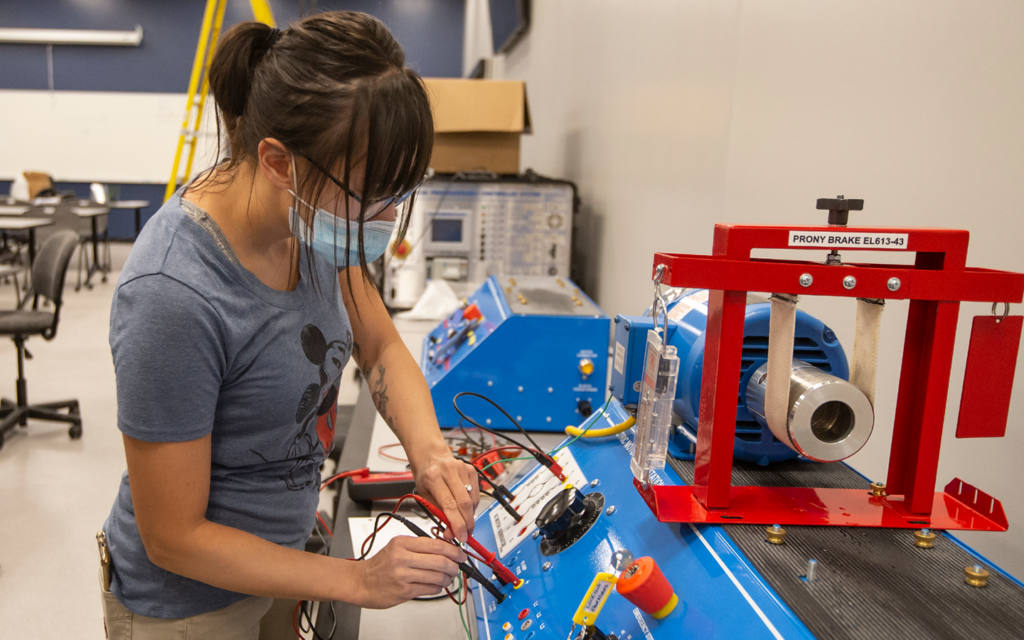
Amy Jones, Associate Dean of Occupational Programs, Engineering & Technology, believes joining SACA will be a great benefit for Schoolcraft College students.
“Today’s manufacturing environment is increasingly complex and computer-connected, and employers are seeking higher levels of technical competency from their employees,” she said. “The SACA certification gives students the technical information to understand and troubleshoot the complex systems found in industry. The certification will attest that the student has learned concepts and can perform various processes learned.”
Further, as a member of SACA, Schoolcraft College can administer the testing without additional fees to students and staff.
Industry 4.0 is resulting in reduced downtime and increased quality, productivity, and overall efficiency in industries of all kinds thanks to advanced technologies that make up what is known as the Industrial Internet of Things (IIoT).
IIoT technologies include advanced robotics, machine learning, artificial intelligence, autonomous vehicles and machines, cloud-based data analysis, and cybersecurity. As companies increase their use of networks and Internet technologies, they are connecting more devices, from smart sensors to smartphones.
“The SACA certification gives students the technical information to understand and troubleshoot the complex systems found in industry.”
Amy Jones, Associate Dean of Occupational Programs, Engineering & Technology
While there are many certifications available today that address isolated competencies, SACA certifications are different. SACA’s Industry 4.0 certifications certify “connected systems” skills that address the integration of the many types of advanced manufacturing technologies with Industry 4.0 technology.
Students will be able to earn SACA certifications at the Associate, Specialist, and Professional level in areas such as basic and advanced operations; robot systems; IIoT, networking, and data analytics; automation systems; production systems; and information technology (IT) operations.
“The certification is important to give students the right skills to gain employment in middle-to-high skill level position,” Jones said. “The various levels of the certification allows students to continue to master higher level skills which can lead to more advanced job opportunities. The certification shows employers what competencies the student can perform on the job.”
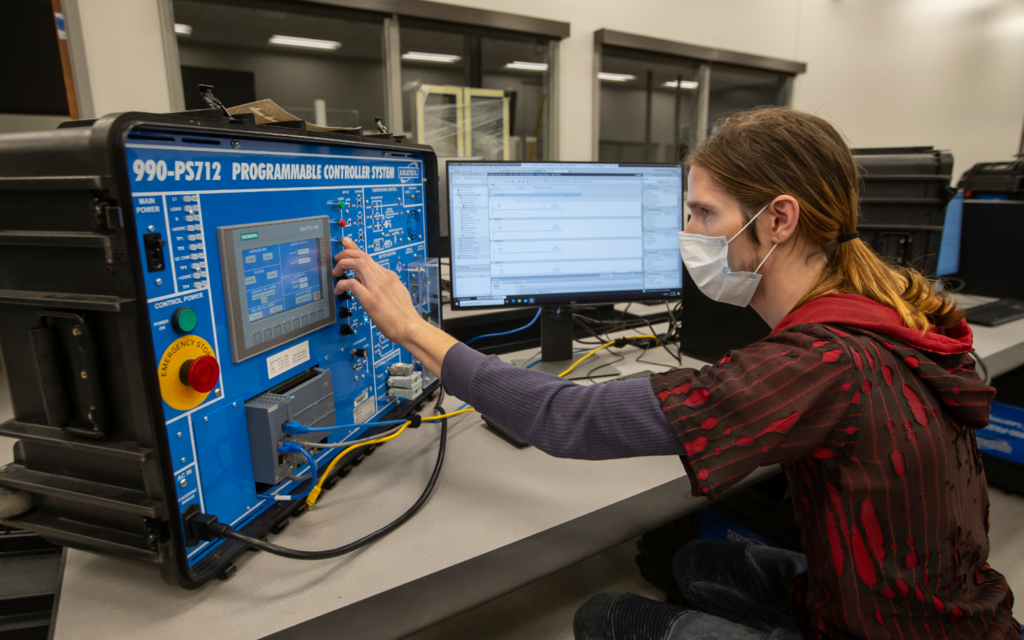
The College plans on implementing the SACA certification in a number of ways. This includes structuring it into the credit programs for Mechatronics Technology, which is being revised for the Spring 2022 semester, so that students earn the credentials as they progress through the curriculum.
“We also have grant programs that will follow a ‘boot camp’ model for short-term training leading to a credential and employment or the student may articulate into our credit program,” said Sandra Miller, Project Coordinator, Business Development Center.
“Finally, SACA offers micro-credentials in a particular subject such as hydraulics. These micro-credentials can be offered by Schoolcraft’s Workforce Training Solutions as customized training for employers to upskill their current workforce.”